Surgical Technique
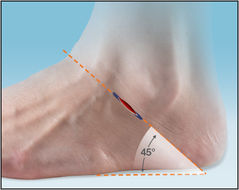
A 1-3 cm incision is made on the lateral side of the foot in the skin overlying the sinus tarsi. Blunt dissection with a hemostat to the level of the joint capsule.
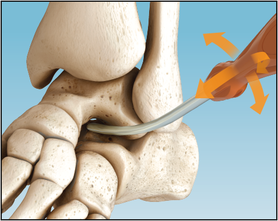
The Viladot’s Lever is introduced through the sinus tarsi. Move the lever slightly dorsal / medial and anterior / posterior to dilate the tarsal canal.
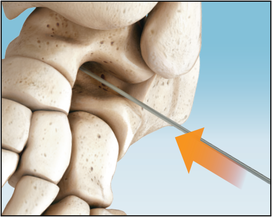
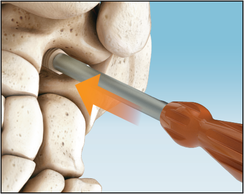
Once the talus is positioned on the calcaneus, the 1.6mm Guide Wire is introduced into the axis of the sinus tarsi until the wire is felt on the medial aspect of the hindfoot. Accurate placement may be confirmed with fluoroscopy.
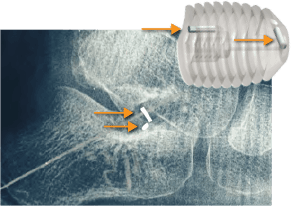
Invisible on X-ray The PitStop® Subtalar Implant facilitates the correction of pes plano valgus deformities.
Anatomical Shape with Lock-in Flanges Biocompatible, PEEK Radiolucence (invisible on X-ray) X-ray Markers for Placement Confirmation
Cannulated Insertion
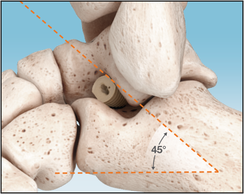
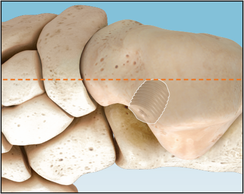
The Inserter is used to press fit the Implant in the correct position with a pushing motion. Do not screw Implant into place. X-ray markers at each end of the Implant help achieve the adequate depth with fluoroscopy visualization. The corresponding flat surfaces of the Implant and Inserter handle are aligned parallel to the lateral talar process, which is an approximate 45° angle to the fibula and the plantar aspect of the foot on the lateral view.
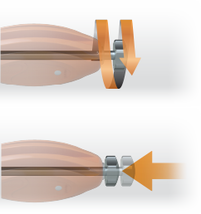
Unscrew the Internal Holder to release the Implant and push with finger pressure to remove the Holder from the Implant.
Hindfoot mobility is assessed to verify adequate correction. The wound should be closed according to surgeon preference.
Related Products
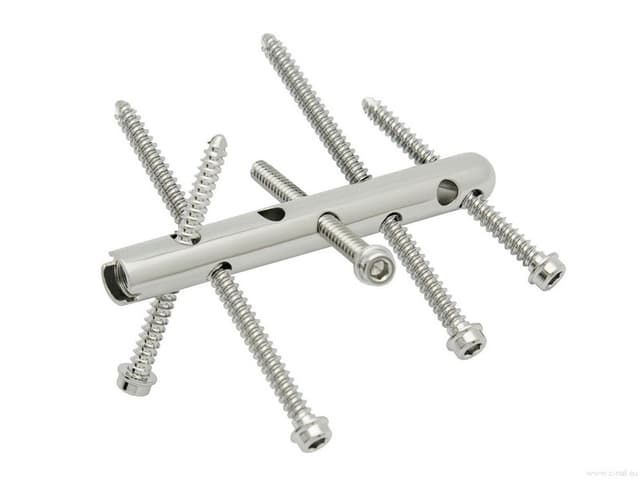
C-NAIL – Intraarticular Calcaneal Fixation
Product Features: Minimally Invasive Approach Only requires small incisions for re-positioning the fragments and inserting the screws and nail High biomechanical stability of Fixation Minimal Risk of Infection Improved hindfoot motion Simple, accurate and reproducible results Indications Intraarticular Fractures Sanders I – IV Joint Depression Type Tongue Type C-NAIL is an intramedullary nail for minimal-invasive fixation of intraarticular calcaneal fractures. The principle is to stabilize with the nail the four to five main fragments of the fractured calcaneus in conjunction with up to seven interlocking screws and thus creating angular stable fixation. The maximum of stability is achieved by fixing the sustentacular fragment towards the nail with two interlocking screws guided by a very precise aiming device. C-Nail Surgical Procedures Record of surgical technique for osteosynthesis of calcaneal bone using C-NAIL. Operating team: Dr. Martin Pompach Dr. Martin Carda Department of Traumatology, Pardubice, Czech Republic
Discover more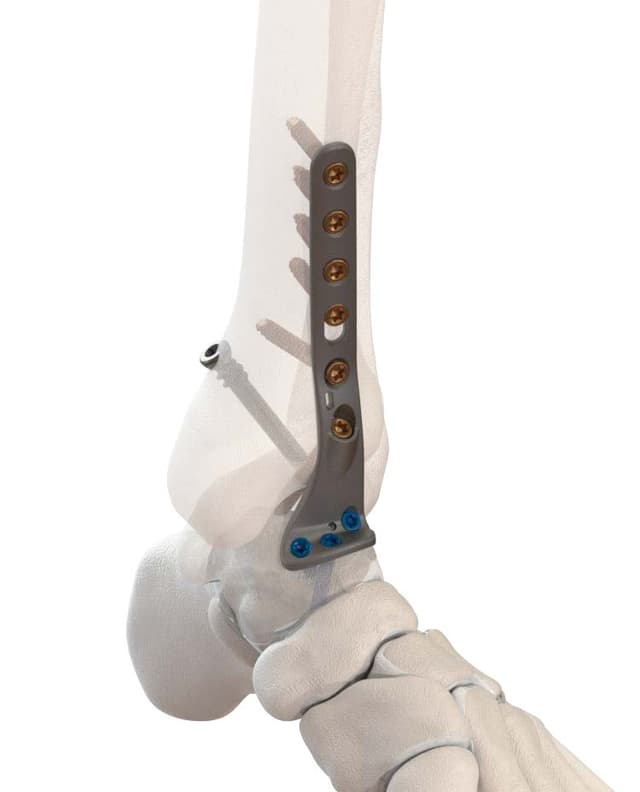
CoLink® NeoFuse – Ankle Fusion Plating
Features: Anatomically Contoured Low-Profile Plates Side-specific Anterior & Anterolateral Plates Targeting Guide for Compression Screw Placement CoLag 6.7mm Compression Screw Variable-Angle Locking Plate Screws Thickness of the plate = 2.5mm – 3.1mm
Discover more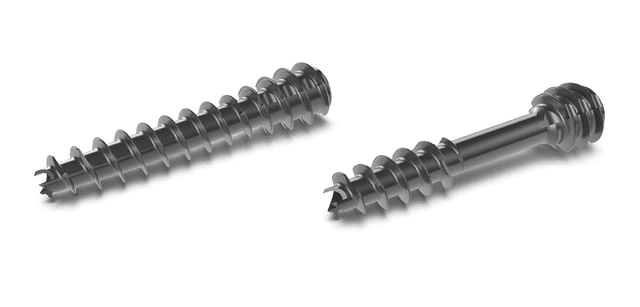
I.B.S. – Large Cannulated Screws
Features: The differential pitch thread shape is designed for optimal grip and penetration through cortical bone. Torx Head – shape supports a higher torque without degradation. Head Conical shape – Increase the perception of stability once it reaches its final position. Made of Titanium alloy Ti6Al4V, the I.B.S.® Mid and Hindfoot screws are available in 4.5mm, 6.5 mm and 8.0mm diameters. The I.B.S.® screws are delivered in a sterile tube. The I.B.S.™ 6.5mm compression screws are available in two versions : 15mm distal thread (C) and 30mm distal thread (C+)
Discover more