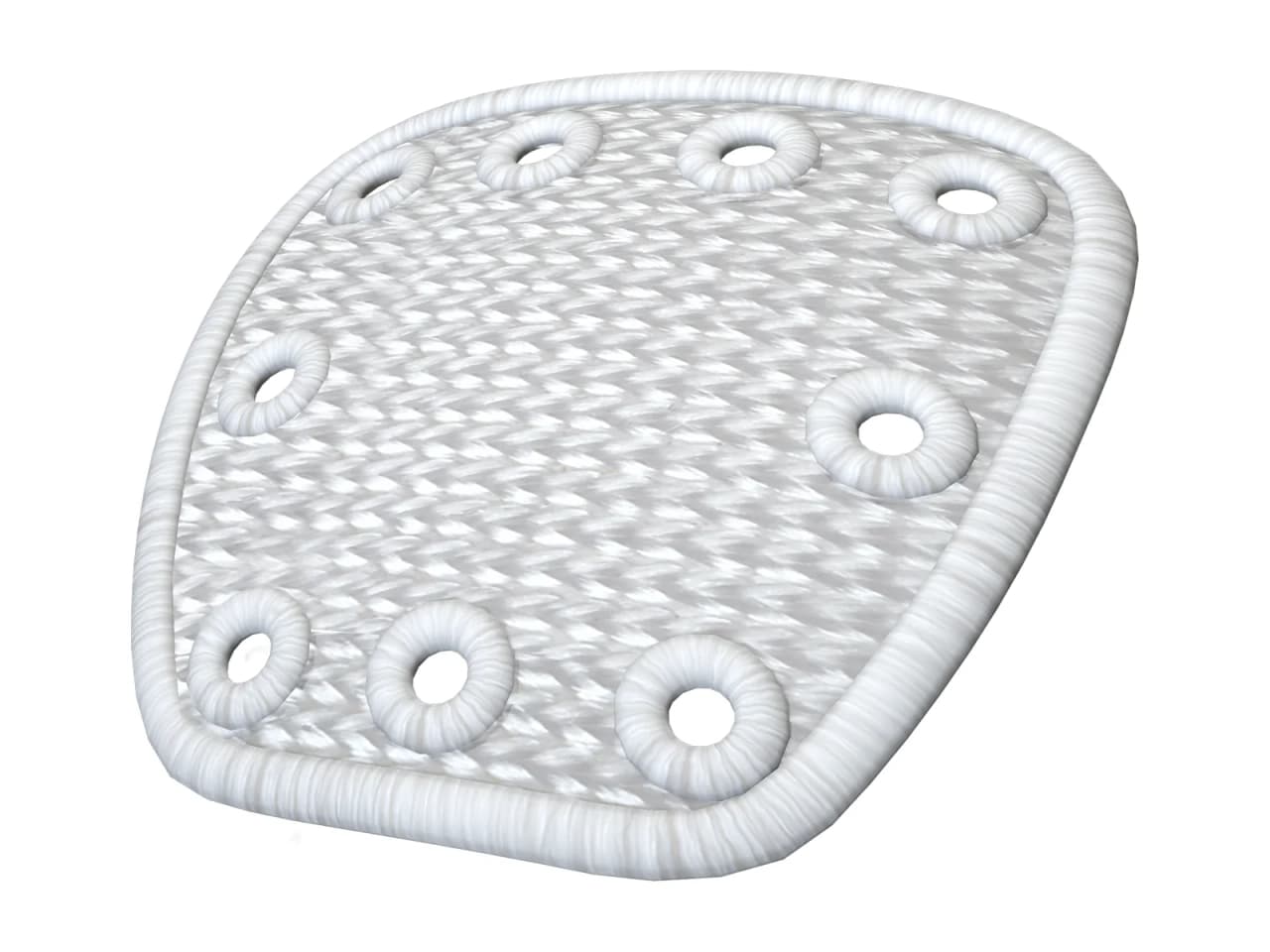
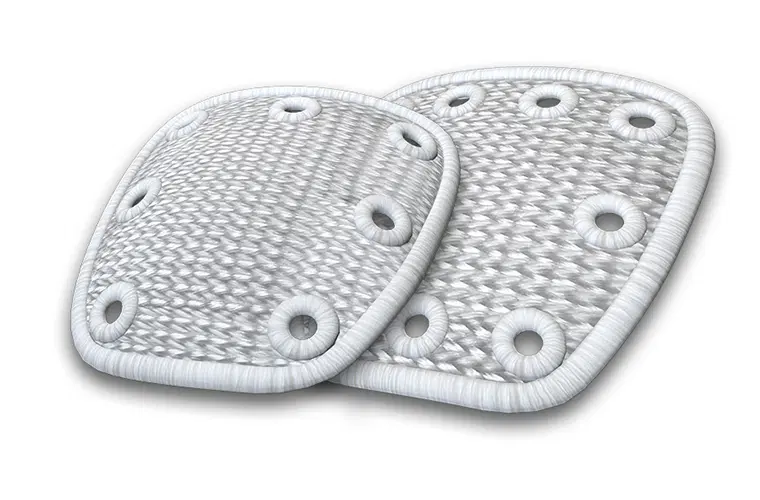
Pitch-Patch is a non-absorbable polyester (poly(ethylene terephthalate) fibre) patch for reinforcing surgical repair of massive rotator cuff tears. It provides additional support where the soft tissue is weak or the repair is incomplete, and is supplied in two anatomical sizes for varying patient anatomy and tear size.
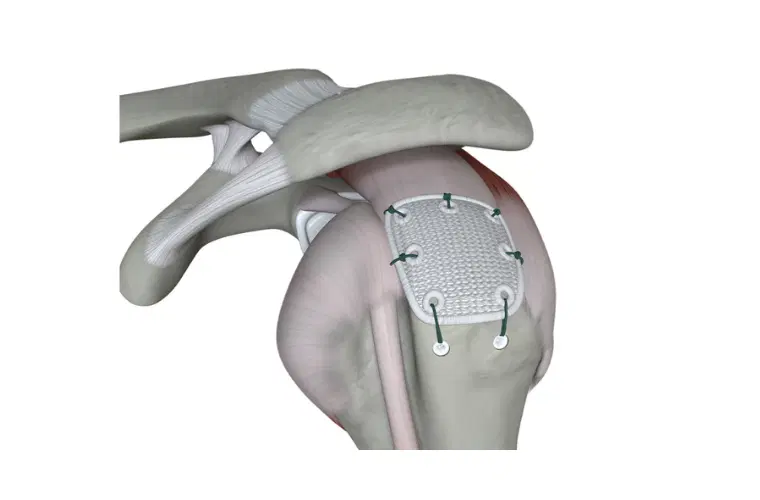
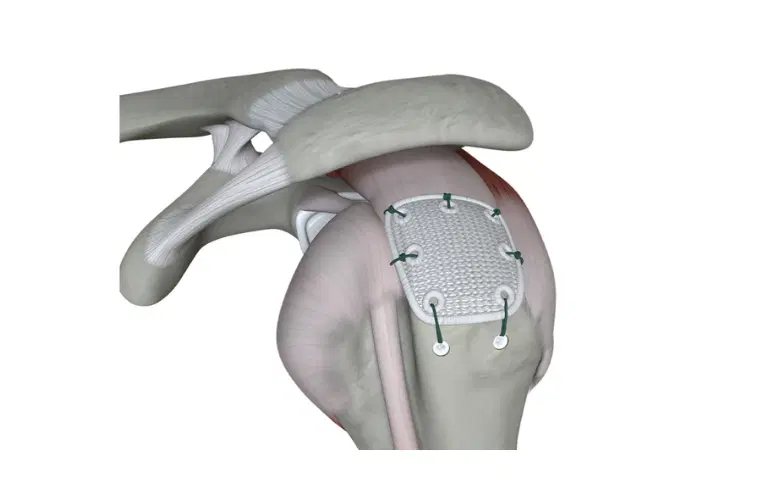
The patch can be placed by open or arthroscopic technique. After the cuff repair, the medial edge is sutured to the tendon, the lateral edge is attached to bone, typically with anchors, and the anterior and posterior edges are sutured to the tendon. The decision on whether reinforcement is needed can be made intra-operatively.
Features
- Strength: 355 N when fully sutured along the medial and lateral edges (manufacturer bench-test data).
- Open or arthroscopic technique: the same device is used for either approach.
- Two anatomical sizes, standard (30 mm x 20 mm) and large (35 mm x 25 mm), for varying patient anatomy and tear size.
- Long shelf life, with no special storage or pre-operative preparation.
- Tissue integration: the device structure allows native tissue to integrate into the patch.
- Rehabilitation: patients follow the same rehabilitation programme as for a primary rotator cuff repair.
Indications
Pitch-Patch is a single-use device intended to be used for reinforcement of the rotator cuff following or during repair by suture or suture anchors. It is indicated for augmentation of rotator cuff repair where the tear cannot be completely repaired using normal methods and/or the quality of the soft tissue is poor. It is for augmentation of the repair, not for bridging or interposition.
It is not intended to replace normal body structure or to provide the full mechanical strength to support the rotator cuff.
Indications, contraindications, warnings and precautions are listed in the instructions for use (IFU).
How it works
See the surgical technique manual for full details of the open or arthroscopic technique before use.
The patch is made from non-absorbable polyester (poly(ethylene terephthalate)) fibres, giving a durable reinforcement for the repair. After repairing the rotator cuff tear, the surgeon selects the size of Pitch-Patch required. The medial edge of the patch is sutured to the tendon and the lateral edge is then attached to the bone, typically with anchors. The anterior and posterior edges are then attached to the tendon. Once in place, the patch reinforces the tendon.
The patient then follows the same rehabilitation plan as for a cuff repair without reinforcement. See the rehabilitation programme.
Clinical evidence
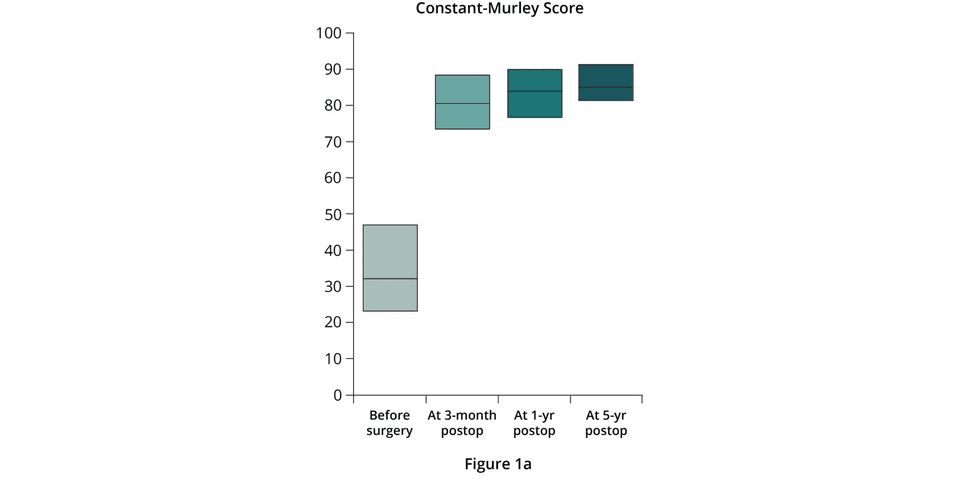
A prospective study of massive cuff tears repaired with Pitch-Patch reinforcement reported functional outcomes and re-tear rates at a minimum of five years after surgery, with function scores continuing to improve between the one-year and five-year time points (figure 1).
A separate retrospective study followed a group of patients with short tendon length (14 mm or less), reporting functional and structural outcomes and clinical failures. Both studies are summarised in the Pitch-Patch Clinical Summary and the published peer-reviewed papers available on this page. Speak with a specialist for more detail on the clinical data relevant to Pitch-Patch.
References cited by Xiros:
- Smolen D et al. Journal of Shoulder and Elbow Surgery 2020;29(1):e11-e21.
- Hess F et al. Trauma International 2023;9(1):01-04 (five-year data, n=50; figure 1).
- Dommer LM et al. Journal of Shoulder and Elbow Surgery 2023;32:2089-2096 (short tendons).
Shoulder function scores for rotator cuff repair augmented by Pitch-Patch
Figure 1 (a, b). Shoulder function scores for rotator cuff repair augmented by Pitch-Patch, before surgery and at 3 months, 1 year and 5 years post-operatively, n=50, from the prospective study by Hess F et al. (Trauma International 2023), summarised in the Pitch-Patch Clinical Summary. The box plots span the interquartile range; the horizontal line inside the box is the median. (a) Constant-Murley score. (b) Subjective Shoulder Value.
Sizes and ordering
Codes from xiros.co.uk. The Xiros Product Portfolio (LAB 142 rev 6.00, January 2025) lists the same patches as 102-1090 and 102-1091, without the XI suffix.
Pitch-Patch (supplied sterile)2 items
| Ref. | Size | Dimensions |
|---|---|---|
| 102-1090XI | Standard | 30 mm x 20 mm |
| 102-1091XI | Large | 35 mm x 25 mm |
Codes and sizes are taken from the manufacturer's marketing literature and may change. For current information, check the Xiros website or the instructions for use before ordering.
Surgical Technique & Brochures
Pitch-Patch Open Technique Animation
Open Technique Virtual Model
Pitch-Patch Arthroscopic Technique Animation
Arthroscopic Technique Virtual Model
Introducing the Pitch-Patch for Reinforcement of Large to Massive Rotator Cuff Tears: Full Technique
Introducing the Pitch-Patch for Reinforcement of Large to Massive Rotator Cuff Tears: Highlights
My experience using synthetics for Rotator Cuff Augmentation with Pitch-Patch - Mr Kuen Chin
Presentation by Dr Jan Leuzinger, British Elbow and Shoulder Society (BESS) 2021
Product information
Can I use the patch if the repair is incomplete?
Yes. Pitch-Patch is indicated in repairs that cannot be completed using standard methods, as long as it is augmenting the repair and not bridging. The strength of the device is measured when attached to sutures, and the minimum strength (355 N) is suitable for reinforcing the repair of a torn tendon.
Can I use the patch to bridge a gap if I cannot close the repair?
No. Pitch-Patch is not indicated for bridging or interposition. It is for augmentation.
Can I use the patch with an open technique and then learn the arthroscopic method?
Yes. The same device is used for the open and arthroscopic techniques, so a surgeon can start with the open technique and move on to the arthroscopic method. Surgical technique manuals for both approaches are available on this page.
How can I obtain training?
Training on the open and arthroscopic techniques can be arranged through Lavender Medical; please contact us.
Can I switch from an arthroscopic to an open approach during a procedure and then use the patch?
Yes. Pitch-Patch can be used with the open or arthroscopic method. The arthroscopic method uses a “parachute” technique to place the device. A decision to change to the open approach should ideally be made before the parachute sutures are set up.
Are there any special rehabilitation requirements?
There are no special requirements. The patient can follow the same rehabilitation programme as for a primary rotator cuff repair.
What happens to Pitch-Patch over time?
Pitch-Patch is gradually encapsulated after a minimal acute inflammatory reaction and integrates with the patient’s tissues. It is not absorbed, nor is any significant change in tensile strength known to occur in vivo.
Pitch-Patch is permanent. Can it be removed?
Pitch-Patch has been shown to integrate with the patient’s tissue, which incorporates between and around the polyester fibres. In the study by Smolen et al., seven revisions were carried out, removing the implant where required. It may not be a suitable option where eventual removal of the device is planned or anticipated.
Does a permanent implant lead to crepitus or frozen shoulder?
Published clinical data report the levels of complications, including frozen shoulder, arthrofibrosis and crepitus. Xiros also collects post-market data. The levels of all such complications recorded to date are within the expected levels for rotator cuff repair with or without patch augmentation.
Instructions for use
Instructions for use are available in the Xiros IFU library.
Used in
Related Products
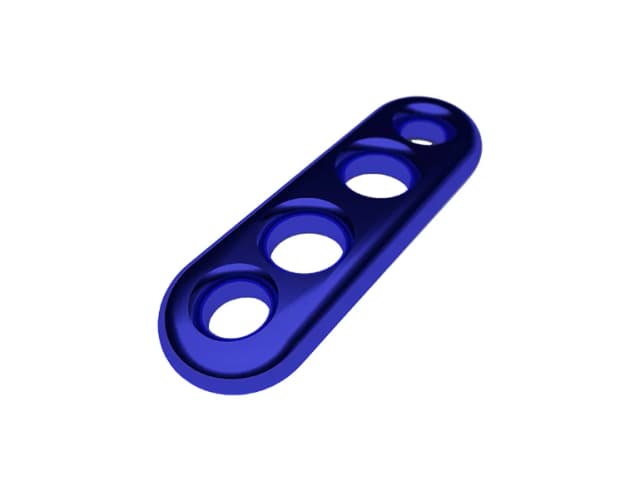
Infinity-Lock™ Button System
Open-weave polyester tape looped around the coracoid and secured with a single clavicular button for acromioclavicular joint stabilisation.
View product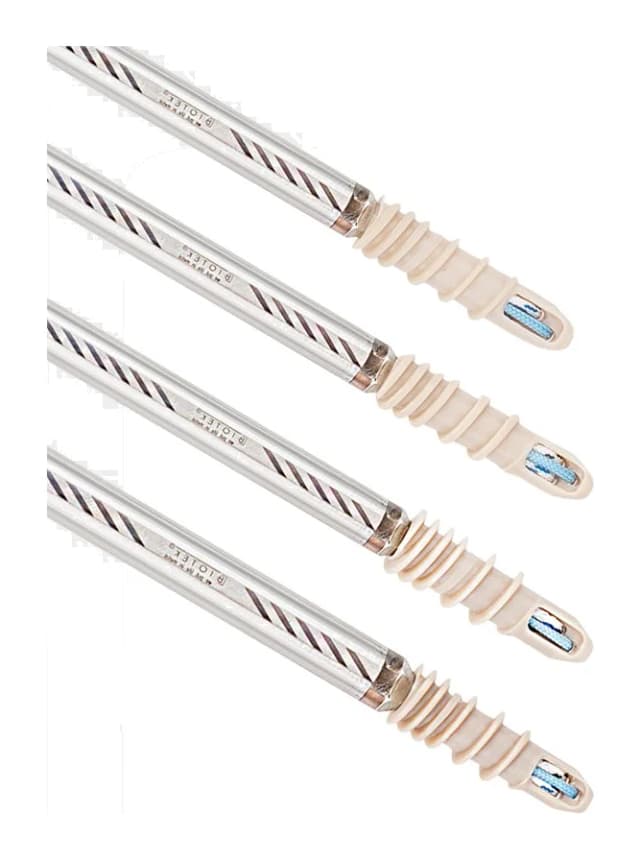
VIMFIX-PK® Ligament Anchor
Fully threaded PEEK screw-in suture anchor for primary or medial row fixation in rotator cuff repair, in 4.5 and 5.5 mm diameters.
View product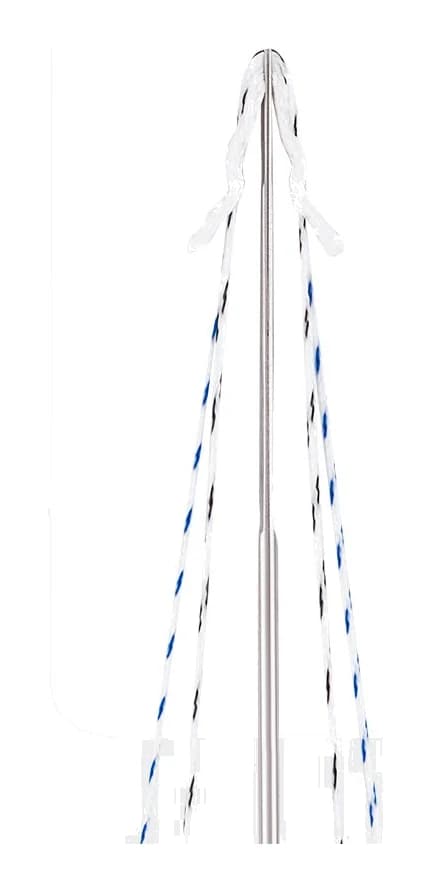
FIBERKNOT® All-Suture Anchors
All-suture UHMWPE anchors in 1.5, 1.8 and 2.9 mm for soft-tissue fixation in the shoulder, hip, elbow, hand, wrist, foot and ankle.
View product